A Needle and a Brush: Capturing Claude Monet's Impressionism in Thread

Monet's The Artist Garden in Giverny 1902


Chasing Light and Color: The Enthralling Life and Works of Claude Monet

Explore the fascinating life and works of this artistic giant, where the sun dances on canvases and landscapes come alive with fleeting impressions.

Monet’s Sunset on the Seine 1875

Early Brushstrokes: A Rebellious Spirit

Born in 1840 in Paris, young Claude displayed an early talent for drawing. Despite his father's disapproval, he persevered, enrolling in art classes, and eventually moving to Paris to hone his skills under various mentors.  However, his unconventional approach, characterized by loose brushstrokes and a focus on light and atmosphere, clashed with the rigid academic style of the time. 

Before becoming a painter, Monet was a popular caricaturist. By the age of 15, Monet had made something of a name for himself with his charcoal caricatures of various Le Havre locals. The pieces, which he sold for 10-20 francs each, were signed “O. Monet” (His first name is Oscar; Claude is his middle name).

 He dreamt of capturing the world's essence, not just copying masters in stuffy studios. His early works were bold caricatures, then seascapes painted en plein air (outdoors!), defying the traditional landscapes of the time. Monet’s Mantra- painting outdoors, and capturing the spontaneity of a moment.

Monet's Camille and Jean in the Garden 1875

Monet’s The Country Cottage 1879

The Birth of Impressionism: Rebelling for a Brighter Light

Undeterred by stuffy art academics, Monet joined forces with other like-minded artists, including Renoir, Pissarro, and Sisley. Together, they challenged the traditional art scene with their revolutionary style. They focused on capturing the fleeting effects of light and color, the play of shadows, and the changing moods of nature. Their works were vibrant, spontaneous, and often unfinished, reflecting the artist's immediate perception rather than a meticulously rendered scene.

Monet’s Christmas Roses 1883


The Salon Shock and the Birth of Impressionism

Their initial exhibitions were met with harsh criticism and ridicule. At the Paris Salon. Monet's 1872 painting "Impression, Sunrise" caused quite a stir.  Capturing the hazy harbor on the Normandy Coast bathed in the golden light of dawn, the loose brushstrokes, the focus on light and shadow were a radical departure from the realism favored by the art establishment. Critics scoffed, calling it "impressionistic," a mocking insult Monet and his friends proudly adopted, ironically becoming the movement's defining label.


From Haystacks to Water Lilies: A Master of Series

Monet’s Houses of Parliament, Sunlight Effect-1900

Monet was fascinated by the interplay of light with different subjects. He painted series of haystacks, capturing the subtle variations in their golden hues as the sun moved across the sky. He found inspiration in the Rouen Cathedral, depicting its majestic form in different weather conditions and light.

Monet’s Garden Path 1902


In 1883, Monet found his haven in Giverny. His gardens in Giverny became his sanctuary and muse. He meticulously designed the landscape, featuring a Japanese bridge and a water lily pond. These water lilies, with their ever-changing reflections and colors, became his obsession. He painted them for over 20 years, creating a mesmerizing series that explored light, movement, and the essence of nature.

Monet’s Garden Luncheon 1873

A Legacy that Endures

Monet's life wasn't just about artistic triumphs. He faced financial struggles, the loss of loved ones, and even partial blindness in his later years. Yet, he persevered, driven by his insatiable passion for capturing the essence of light and the beauty of the world around him.  Claude Monet passed away in 1926, leaving behind a legacy that continues to inspire artists and art lovers alike. He wasn't just a painter; he was a poet of light, a magician of color, and a relentless seeker of beauty. His works continue to transport us to sun-drenched landscapes, shimmering water lilies, and the fleeting moments of a world bathed in ever-changing light. His legacy extends far beyond the Impressionist movement. He paved the way for modern art, influencing artists like Cézanne and Van Gogh. While Cézanne developed his own unique style, his early works show the influence of Monet's loose brushwork and focus on structure. He later became a key figure in Post-Impressionism and paved the way for Cubism. Van Gogh was deeply influenced by Monet's use of color and expressive brushwork. His vibrant landscapes and swirling brushstrokes owe a debt to Monet's innovations.


Monet’s influence extended far beyond his contemporaries.

Monet’s Studio in Giverny 1920

Abstract Expressionists like Jackson Pollock and Mark Rothko were drawn to his large-scale canvases and loose brushwork. Pop Art icon Andy Warhol found inspiration in Monet's repetitive depictions of the same subject, such as his haystacks. Warhol's famous Campbell's Soup series echoes this idea.

Here are a few of Monet’s masterpieces that forever altered the course of art:

Impression, Sunrise (1872): Where it all began. This seemingly simple depiction of a harbor at dawn holds immense significance. Its loose brushstrokes and focus on capturing the fleeting effects of light not only gave birth to the term "Impressionism" but also challenged the rigid conventions of art at the time.

Woman with a Parasol – Madame Monet and Her Son (1875): More than just a portrait, this painting embodies the essence of Impressionism. The dappled sunlight filtering through the leaves, the blurred figures, and the focus on atmosphere over precise detail showcase Monet's masterful manipulation of light and shadow.

The Rouen Cathedral Series (1892-1894): Monet wasn't one for singular perspectives. This series, depicting the majestic Rouen Cathedral at various times of day and in different weather conditions, highlights his fascination with the ever-changing nature of light and its impact on our perception.


The Water Lilies (1896-1926): An immersive dreamscape. Monet's iconic Water Lilies series, painted in his later years, transcends mere representation. The hazy reflections, the vibrant colors, and the sense of tranquility invite viewers to lose themselves in the beauty of his water garden.


Haystacks (1889-1891): Beauty in the mundane. This seemingly ordinary subject became a canvas for Monet's exploration of light and color. The series, depicting haystacks at different times of day and seasons, showcases his ability to find beauty in the everyday and elevate it to the realm of art.

Modern Day Monet’s Garden at Giverny-Clos Normand

Visiting the Master's World

You can Immerse yourself in Monet's world by visiting his home and gardens in Giverny, it is now a museum! Nestled in the idyllic Normandy countryside, Giverny wasn't just Monet's home; it was his muse. Stepping into this masterpiece is like stepping into a living Monet painting, a reminder of the beauty that surrounds us and the artist's ability to capture its fleeting essence.  He meticulously transformed the two distinct gardens – the Clos Normand and the Japanese Water Garden – into living masterpieces. 

Modern Day Monet’s Garden at Giverny-Clos Normand

The Clos Normand, inspired by Dutch flower gardens, unfolds in a riot of color. Towering hollyhocks in shades of pink, red, and purple stand sentinel, while pathways wind past carpets of poppies, daisies, and irises. Weeping willows cast dappled shadows, and the quaint pink house, immortalized in countless paintings, completes the idyllic scene.

 Modern Day Monet’s Garden at Giverny-Clos Normand

When you cross the road and enter a world of serene beauty. The Japanese Water Garden, a labor of love for Monet, transports you to another realm. The iconic Japanese bridge, a vibrant red against the emerald landscape, beckons you across the water lily pond. Weeping willows dip their branches into the still water, reflecting the sky in their leaves. Water lilies, Monet's obsession, paint the surface in a palette of white, pink, and yellow, their delicate beauty mirrored in the countless paintings they inspired.

Claude Monet in front of his murals in 1923


Today, Giverny Gardens welcomes over 500,000 visitors each year, each drawn by the magic Monet created. It's a testament to the power of nature and art to inspire, transport, and leave an indelible mark on our souls. Whether you're an art enthusiast, a nature lover, or simply seeking a moment of tranquility, Giverny Gardens offers an experience unlike any other.


Monet’s Japanese Bridge Giverny 1896

Read more →

71-Year-Old Visionary: How Mary Delany Invented Modern Collage-

Stitching the Past, Inventing the Future With Her 18th-Century Mixed Media Botanicals

Rhododendron Blossoms
Mary Delany was famous for her highly accurate and beautiful botanical illustrations. Unlike most botanical illustrations, these are not paintings, but paper collages created from hundreds of tiny pieces of cut paper.r her highly accurate and beautiful botanical illustrations. Unlike most botanical illustrations, these are not paintings, but paper collages created from hundreds of tiny of cut paper.

Mary Delany Brilliant Paper Mosaic Artist of Botanicals


 MARY GRANVILLE PENDARVES DELANY

Mary Granville Pendarves Delany, 1700 –1788, was born at Coulston, England. She was one of 4 children of Colonel Bernard Granville and Mary Westcombe Granville. Both of her parents were Tory supporters of the Stuart Crown.  When Mary was young, her parents moved the family to London.  Mary became a regular visitor to the Court when she was sent to live with her aunt, Lady Stanley, who was childless.  While living with Lady Stanley, Mary was educated in English, French, history, music, needlework and dancing. The plan for Mary's to become a lady in waiting were thwarted when Queen Anne died 1714.  The Granvilles moved to Gloucestershire, where they were very isolated from English society. Mary was able to concentrate and continue her education.

Magnolia Blossom and Leaves

Near the end of 1717, Mary was invited to stay with her uncle, Lord Lansdowne, in Wiltshire. She was introduced to Alexander Pendarves a man that her family hoped would marry her.  Pendarves who was a Member of Parliament was 60 years old and Mary was 17 when the two were married in 1718.

The Pendarveses lived in Roscrow Castle in Cornwall until 1921 when her husband’s ill health caused the couple to return to London.  Mary became the primary caregiver of her husband and although it was a busy time as it was also a nice for Mary to be reunited with family and friends. In 1724, Mr. Pendarves died in his sleep, leaving his young wife a widow at the age of 23.

Mary Granville Pendarves

Mr. Pendarves had not altered his will after his marriage, and so Mrs. Pendarves did not inherit what remained of his estate. Despite her lack of resources, widowhood provided new opportunities for Mrs. Pendarves. Widows, unlike unmarried women, were able to move more freely in society, and for the first time in her life, Mrs. Pendarves was able to pursue her own interests without the oversight of any man. Because she had no home of her own Mrs. Pendarves spent time living with various relatives and friends. She spent time in Ireland with her friend Mrs. Donnelly and while there Mrs. Pendarves made the acquaintance of Patrick Delany, an Irish clergyman who was already married. In 1743 Patrick Delany married Mrs. Pendarves.

The Delany’s passed a year in London before moving to Dublin, where Patrick Delany had a home. Both husband and wife were very interested in botany and gardening: They shared a mutual pleasure in their garden at Delville near Dublin.  Patrick Delany supported and encouraged Mary in her gardening, painting, shell-work and needlework much of which was inspired by flowers and their garden.

Tiger Lily

In 1768, after twenty-five years of marriage, and at the age of 84, Patrick Delany died. So once again, at the age of 68, Mary Delany found herself a widow. As a widow, Mary Delany spent even more of her time at Bulstrode, the home of her close friend, Margaret Bentinck, Dowager Duchess of Portland. The two shared a love of botany, often going out to look for specific specimens. It was during her frequent stays at Bulstrode with the Duchess that Mary became acquainted with two well-known botanists of the time Joseph Banks and Daniel Solander. This contact with the botanists only continued Mary’s education and her interest in botany.


Nodding Thistle

Mary Delany was a gifted and talented artist.  The fact that she actually started creating her paper mosaics when she was in her seventies show what an extraordinarily gifted artist she was.


Passion Flower

Mary Delany had always loved the arts. During her marriage to Dr. Delany she had the time to hone her skills.  She was an avid gardener, and was also good at needlework, drawing, painting, however, she was best known for her paper-cutting skills.  "For these 'mosaicks' are coloured paper representing not only conspicuous details but also contrasting colours or shades of the same colour so that every effect of light is caught” From the book Mrs Delany: her life and her flowers by Ruth Hayden (London: British Museum Pubs. Ltd., 1980.

She teamed up with a friend who was a watercolourist and miniaturist, with whom she embarked on a number of artistic projects.

Fritillaria Flower

In 1771, when Mary was in her early 70s and as a way of dealing with her grief, Mary began to create cut out paper artworks (decoupage) as was the fashion for ladies of the court. Her works were exceptionally detailed and botanically accurate depictions of plants. She used tissue paper and hand colouration to produce these pieces. She created 1,700 of these works, calling them her "Paper Mosaiks", from the age of 71 to 88. From the book Mrs. Delany: her life and her flowers by Ruth Hayden (London: British Museum Pubs. Ltd., 1980.

Pink Hollyhock

Her process was to set the plant in front of her and cut minute particles of colored paper to represent the petals, stamens, calyx, leaves, veins, stalk and other parts of the plant, and, using lighter and darker paper to form the shading, she stuck them on a black background. By placing one piece of paper upon another she sometimes built up several layers and in a complete picture there might be hundreds of pieces to form one plant. Mary took great care to make sure that each of her flowers were correct, in number of stamens and petals. She also became so well known that many donors began to send her flowers to create Mosaics from. Today, her mosaics can still be seen at the British Museum in the Enlightenment Gallery.

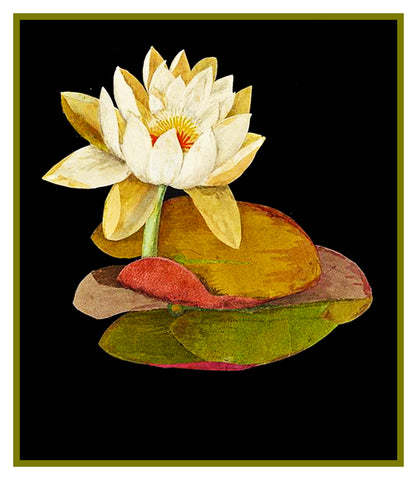
Water Lily

 “Mary Granville, then Pendarves, then Delany was a complicated character in a multi-leveled, socially ornate world. But if a role model in her seventies isn't layered with contradictions – as we all come to be – then what good is she? Why bother to cut the silhouette of another's existence and place it against our own if it isn't as incongruous, ambiguous, inconsistent, and paradoxical as our own lives are?

Asphodel Lily

A few of the papers she used — all of the papers in the eighteenth century were handmade — in fact were wallpapers, but mostly she painted large sheets of rag paper with watercolor, let them dry, then cut from them the hundreds of pieces she needed to reproduce — well, to re-evoke might be a better word — the flower she was portraying. There is no reproduced hue that matches the thrill of color in nature, yet Mrs. D. went after the original kick of natural color, and she did it like a painter. If you look at photographic reproductions of her work in a book like this, you may swear to yourself that her flowers are painted. But if you go to the British Museum Web site, zoom in on the image, then zoom in again and again, at last you will see the complicated overlapping layers of cut paper that this book shows in enlargements of details.” From the book The Paper Garden: An Artist (begins Her Life's Work) at 72.by Molly Peacock, New York, NY ; Berlin Bloomsbury, 2011


Calla Lilies

 We are so excited to introduce to you the counted cross stitch and counted needlepoint charts inspired by Mary Delany's magnificent work!

For further reading:

1.) Mrs. Delany: her life and her flowers by Ruth Hayden (London: British Museum Pubs. Ltd., 1980

2.) The Paper Garden: An Artist (begins Her Life's Work) at 72.by Molly Peacock, New York, NY ; Berlin Bloomsbury, 2011

Wikipedia

Read more →

Sirens and Sorcery: The Mythic Allure of John William Waterhouse

The Soul of a Rose detail Painted by John William Waterhouse 1903

John William Waterhouse (1849-1917) was an English painter who captured the Victorian imagination with his dreamlike depictions of classical and literary themes. His canvases, rich in detail and infused with a sense of sensuality and drama, transported viewers to ancient worlds and legendary realms.

The Annunciation Painted by John William Waterhouse 1994


Waterhouse's artistic trajectory shifted when he encountered the works of the Pre-Raphaelite Brotherhood. He was captivated by their meticulous attention to detail, vibrant colors, and focus on emotional narratives. He adopted their stylistic elements, injecting his own brand of sensuality and drama into his scenes. He was inspired by a wide range of artists in addition to the Pre-Raphaelites, including Edward Burne-Jones and Frederic Leighton. Waterhouse’s supporters saw his paintings as celebrations of feminine power and the timeless allure of myth and legend.

Juliet Painted by John William Waterhouse 1898

Waterhouse's signature style emerged in the 1880s, when he began focusing on female figures from myth and legend. His heroines were often portrayed in moments of vulnerability and emotional intensity, their beauty enhanced by rich fabrics, flowing hair, and evocative settings. Paintings like "Psyche Opening the Casket" (1894) and "The Lady of Shalott" (1888) cemented his reputation as a master of depicting female longing and desire. It is thought that Waterhouse art often used symbolism and allegory. Many of his paintings contain hidden meanings and references to classical mythology and literature.

The Lady of Shalott Painted by John William Waterhouse 1888

Beyond his female figures, Waterhouse also explored other themes, including Arthurian legend, Shakespearean adaptations, and even contemporary genre scenes. Yet it was his mythological and literary heroines that truly captured the public imagination. His paintings graced the walls of Victorian homes, book illustrations, and even popular advertising.

Miranda from the Tempest Painted by John William Waterhouse 1916

John William Waterhouse's work was not without its share of controversies, particularly during his own time in the Victorian era. Here are some of them: 

Focus on Female Beauty and Sensuality:

  • Many critics found Waterhouse's focus on female figures, often depicted in flowing gowns and suggestive poses, excessive and bordering on prurience. Paintings like "A Mermaid" (1900) and "The Lady of Shalott" (1888) attracted criticism for their portrayal of female allure.

The Mermaid Painted by John William Waterhouse 1900


Departure from Traditional Mythological Depictions:

  • Some of Waterhouse's interpretations of classical myths diverged from established artistic conventions, raising eyebrows among more conservative viewers. For example, his "Echo and Narcissus" (1903) depicts the transformation with a sensuality that shocked some who were accustomed to more chaste representations of the myth.

Echo and Narcissus Painted by John William Waterhouse 1903


Artistic License and Historical Accuracy:

  • Waterhouse often took liberties with historical and mythological details in his paintings, prioritizing artistic expression over strict adherence to factual accuracy. This approach, while liberating for his creativity, sometimes drew criticism from purists who preferred a more literal interpretation of the source material.

Psyche entering Cupid's Garden Painted by John William Waterhouse 1903


Modern Re-evaluations and Feminist Interpretations:

  • In recent years, Waterhouse's work has been re-evaluated through a modern lens, sparking new interpretations and discussions. Some feminist scholars see his paintings as empowering portrayals of female desire and agency, while others still view them as objectifying and catering to the male gaze.

The Shrine Painted by John William Waterhouse 1895


Balancing Controversy with Popularity:

  • Despite the controversies, Waterhouse's paintings remained immensely popular during his lifetime and continue to be admired today. His ability to tell stories through beautiful imagery and evoke strong emotions in viewers has secured his place as a significant figure in art history.

It's important to remember that art appreciation is subjective, and interpretations of Waterhouse's work will vary depending on individual perspectives and historical contexts. The controversies surrounding his work serve as a reminder of the ever-evolving nature of art and its power to evoke strong reactions in viewers.

A Song of Springtime Painted by John William Waterhouse 1913

Despite his versatility, it's the mythological and literary heroines that cemented Waterhouse's legacy. His paintings graced the walls of Victorian homes, book illustrations, and even popular advertising. He became a household name, a visual storyteller who breathed life into ancient myths and legendary tales.

The Soul of a Rose Painted by John William Waterhouse 1903

Waterhouse's enduring appeal lies in his ability to transport viewers to fantastical realms. His meticulous attention to detail creates a sense of tangible reality, while his masterful use of light and shadow imbues his scenes with drama and emotion. The women he portrays are not simply passive figures; they are vessels of passion, desire, and vulnerability, drawing viewers into their emotional worlds.

A Set of Tarot Cards based on Waterhouse’s Art

Waterhouse's influence extends far beyond his time. His works continue to inspire contemporary artists, writers, and even filmmakers. His ability to weave dreams in brushstrokes remains as captivating today as it was over a century ago.


Lamia Painted by John William Waterhouse 1905

Waterhouse continued to paint until his death in 1917, his artistic output remaining remarkably consistent throughout his career. Today, his works are found in major museums around the world, and his popularity continues to grow. He is celebrated as a master storyteller, a magician of light and color, and a painter who brought the myths and legends of the past vividly to life. Waterhouse's legacy is that he is considered one of the most important Victorian painters, and his work continues to inspire artists and writers today.

Fair Rosamund Painted by John William Waterhouse 1916


Read more →

Designing Joy: The Visual Legacy of the Nimble Nicks Curious & Mysterious

TT

The Nimble Nicks Santa’s Colorful Cute and Happy Helpers!

I have always loved the Nimble Nicks characters.  As I started to research them I realized having been raised in Massachusetts of course I would have an interest in characters that were born-created in Worcester Massachusetts. There is not a lot of information about the history of the Nimble Nicks but the article written by Roy Nunn and published in The Antique Shoppe Newspaper in December of 2004 provides great insight into these cute Santa’s helpers.


 Interior view of George C. Whitney Company with workers, c. 1888. Photograph from the collections of Worcester Historical Museum.


Here is Roy Nuhn’s article:

The publishing company founded by Civil War veteran George Whitney in his hometown of Worcester, Massachusetts, has long been dear to the hearts of collectors everywhere because of its beautiful 19th-century valentines. But Whitney has also gained much admiration and respect for having made the Yuletide, in the years before World War I, a happier, more colorful holiday. Beginning at the turn of the century and continuing up to about 1920, the Whitney Company manufactured huge numbers greeting cards, children's books, souvenir postcards, paper toys and novelties of every description for Christmas. They were also involved with other holidays, including Halloween, Easter, valentine's Day, etc. But Christmas was the big selling season, just as it was - and still is - for most publishers.

In the process of creating and marketing this huge output of merchandise for the nation's five-and-dimes, department stores, variety shops, and other retail outlets, Whitney introduced a line of Nimble Nicks products.

One of the earliest, if not the first, ensemble of characters especially created by a publisher for its paper novelties, the Nimble Nicks were Santa's helpers. Others - Rose O'Neill's Kewpies, Palmer Cox's Brownies and R. F.Outcault's Buster Brown among them - began as magazine illustrations, dolls, or comic strip heroes and heroines. The Nimble Nicks - cute little guys who loved a good time almost as much as they loved helping Santa make toys and get ready for his once-a-year Christmas Eve trip - were American originals. They came along a half-century after George Whitney had started his valentine business.

During the heyday of the picture postcard fad in the United States, from about 1904 to 1917, the Whitney Company was a major presence. They printed and sold several hundred designs for all holidays. So vast was its production that collectors even today still do not know for sure the entire story.

 Brightly colored, embossed Christmas postcards featuring cheery, pleasant children were issued in sets of six. The same artwork was also used for other holiday novelties, including greeting cards, prints, and softbound juvenile books. Whitney's Santa Claus illustrations, for instance, provided pictorials for Christmas greeting cards, paper toys and picture books. These showed Santa, often with children, unpacking his toys, leading wish lists, trudging through the snow, and placing gaily-wrapped packages under Christmas trees.

And then there were the Nimble Nicks.

On postcards and other paper goods and in storybooks, they were probably introduced about 1915 and stayed around until the early 1920s. Many Nimble Nicks souvenir postcards - at least two dozen of them - were printed, each in runs of tens to hundreds of thousands of copies. Countless other merchandise, including easel stand-ups, were also produced, as well as illustrated books.

Nimble Nicks may well have been the world's first companions for Santa Claus. Others, like Rudolph and Frosty, came along much later.

Each delightful Nimble Nick was a playful little imp whose greatest thrill in life was wearing a tiny Santa Claus suit. Their charm has endured well over the years, and many collectors today are in love with them.

 They lived in a fantasy place called Christmas Land, where snow remained year-round. At first, they are usually mistaken for fairies, elves or pixies. However, a closer examination reveals the chubby fellows - and gals (there's one of them) - to be no more than children who never grow up.

They are taller and larger than the various mythical forest creatures they are often confused with, and they are perfectly proportioned. Each Nick has blonde hair and one curl at the top of his forehead which peaks out from under the red hood. The hair, diminutive size, and Santa Claus outfits are their trademarks, forever tagging them as Nimble Nicks.

The Nicks dwelled in cute tiny houses that did not even reach a regular person's knee and they drove around Christmas Land in kiddie-cars (so the illustrated storybooks tell us). Also, at party time, out came the "funny little chairs" upon which the little fellows sat while eating their favorite treat, turkey stew.

When not helping Santa Claus, the Nicks enjoyed life to the hilt. One of their greatest pleasures was to bunch up as many of themselves as possible, as close as they  could, onto giant sleds and go cascading down giant snow-covered hills. Another activity enjoyed by all was incessant snowball fighting.

Whitney published its many different designs of the Nimble Nicks in vivid red coloring. These, like the firm's other Christmas merchandise, were sold in the nations stores, particularly Woolworth's, well into the late 1920s and early 1930s, though the actual printing of them had stopped years before around 1925.

 Several books aimed at young people between the ages of three and ten were printed by Whitney detailing the adventures of the Nimble Nicks. These were usually die-cut, 6 x 9 inches in size, and average about 12 illustrated pages. Today such books are very rare.

 Whitney also marketed a paper novelty product line known as easel stand-ups. The top half of the design was a die-cut and popped out of its perforations when folded backward and clipped with a tab. The card could then stand up, and part of the illustration was free-standing. About a half-dozen Nimble Nicks designs were printed in this format.

Employees of the George C. Whitney Whitney George C Company Employees, c .1898

The greeting card company that once flourished under the guiding hand of George C. Whitney has been gone now for well over a half-century, but collectors continue to be intrigued and passionate about the valentines, postcards and books the firm published in its 80-year lifetime. To these collectors nothing is more treasured today than the ephemera associated with the Nimble Nicks - Santa's helpers up North in a place called Christmas Land.

We hope you enjoy the Nimble Nicks and all their antics as much as we do.


Be Sure to Check Out the Patterns we have created featuring the Nimble Nicks.


Read more →

Feathers and Fire: The Untamed Visionary Art of John James Audubon

 JOHN JAMES AUDUBON AMERICAN NATURALIST


John James Audubon 1785 – 1851, was an American ornithologist, naturalist, and painter. He is known for his extensive studies documenting all types of American birds as well as his detailed illustrations that depicted the birds in their natural habitats. His major work, a color-plate book entitled The Birds of America (1827–1839), is considered one of the finest ornithological works ever completed. Audubon identified 25 new species.

Oil, 1841 by Victor and John W. Audubon John James Audubon's Sons

John James Audubon, was born as Jean-Jacques Audubon in the French Colony of Saint-Dominigue (now Haiti).  Audubon had an immediate interest in nature and birds and drawing in his childhood. Audubon became one of the most distinguished illustrators of the 19th century. Audubon had a diverse and exciting life. Born in Haiti he moved to France at the age of four.  He loved the woods and exploring and spent many hours observing nature. When he was 18 years old, he moved to the United States.  Originally named Jean Jacques, he changed his name to John James to sound more American. He lived in Mill Grove Pennsylvania on his family farm. While in Mill Grove Audubon explored and enjoyed spending time in  nature and he studied American birds and he came up with the technique of bird banding, which helped him to study the same birds, longevity, migration and other patterns of life. 

Great White Heron from  Audubon's Birds of America

During a visit to France he studied taxidermy with naturalist and physician Charles-Marie D'Orbigny.  After his return to the United States, Audubon resumed his bird studies and started a nature museum in Pennsylvania featuring his own taxidermy and specimens. Audubon had several failed business ventures and often hunted and fished to feed his family. During his hunting expeditions, he observed and drew specimens and learned techniques of hunting.

Bay Owl Detail from Audubon's Birds of America

John was determined to find and paint all the birds of North America. He vowed to create a better study of The Birds of North American that the one created by the poet and naturalist Alexander Wilson.  In late 1820, Audubon set out to explore the Ohio and Mississippi rivers to study the birds. He travelled with the Swiss Landscape artist George Lehman in search of ornithological specimens. He supported himself by painting portraits of people and by teaching painting to a few students. 

 In 1824 Audubon began to look for a publisher for his drawings. He was unable to reach an agreement with American publishers and traveled to Europe with hopes of obtaining a publisher. In 1826, at the age of 41, Audubon arrived Europe He was favorably received, being referred to as the “American Woodsman”. He Traveled around England and Scotland to raise money to publish his work. His work on “Birds of America” consisted of images of around 700 species of North American birds. While in London, he signed up subscribers for his volumes and a deal with a publisher in London. By 1827, the first volume of “Birds of America” were published. It took 11 years for all the volumes to be published.


Atlantic Puffins from Audubon's Birds of America

 In 1829, Audubon returned to America and added more drawings to his collection. Audubon also hunted animals and sent the skins back to his British friends. The success of “Birds of America” brought him some fame. In 1930 he was elected to be a fellow at the American Academy of Arts and Sciences. Audubon had earned enough from publishing of his books, he bought an estate on the Hudson River.


The Audubon's named their home Minniesland.  The Audubon Estate on the Banks of the Hudson. Foot of 156th Street at Carmansville.  Lith. of Major and Knapp, 444 Broadway, N.Y.  For D. T. Valentine's Manual, 1865.

 While on his excursions to the West to observe Western species, Audubon’s health began to deteriorate. He became quite senile by 1848 and suffered a stroke that year. He died in 1851. 

John James Audubon, portrait by John Woodhouse Audubon 1843

Audubon's Achievements

  • Audubon's influence on ornithology and natural history was far reaching. Nearly all later ornithological works were inspired by his artistry and high standards. Charles Darwin quoted Audubon three times in On the Origin of Species and also in later works.[83] Despite some errors in field observations, he made a significant contribution to the understanding of bird anatomy and behavior through his field notes. Birds of America is still considered one of the greatest examples of book art. Audubon discovered 25 new species and 12 new subspecies
  • He was elected to the Royal Society of Edinburgh, the Linnaean Society, and the Royal Society in recognition of his contributions.
  • The homestead Mill Grove in Audubon, Pennsylvania, is open to the public and contains a museum presenting all his major works, including Birds of America.
  • The Audubon Museum at John James Audubon State Park in Henderson, Kentucky, houses many of Audubon's original watercolors, oils, engravings and personal memorabilia.
  • In 1905, the National Audubon Society was incorporated and named in his honor. Its mission "is to conserve and restore natural ecosystems, focusing on birds..."
  • He was honored by the United States Postal Service with a 22¢ Great Americans series postage stamp.
  • On December 6, 2010, a copy of Birds of America was sold at a Sotheby's auction for $11.5 million, the second highest price for a single printed book.

Audubon's Legacy

Audubon developed his own methods for drawing birds. First, he killed the birds using fine shot. He then used wires to prop them into a natural position, unlike the common method of many ornithologists, who prepared and stuffed the specimens into a rigid pose. When working on a major specimen like an eagle, he would spend up to four 15-hour days, preparing, studying, and drawing it. His paintings of birds are set true-to-life in their natural habitat. He often portrayed them as if caught in motion, especially feeding or hunting. This was in stark contrast to the stiff representations of birds by his contemporaries, such as Alexander Wilson. Audubon based his paintings on his extensive field observations.  Audubon worked primarily with watercolor early on. He added colored chalk or pastel to add softness to feathers, especially those of owls and herons. He employed multiple layers of watercolor paints. All species were drawn life size which accounts for the contorted poses of the larger birds as Audubon strove to fit them within the page size. Smaller species were usually placed on branches with berries, fruit, and flowers. He used several birds in a drawing to present all views of anatomy and wings. Larger birds were often placed in their ground habitat or perching on stumps. At times, as with woodpeckers, he combined several species on one page to offer contrasting features. He frequently depicted the birds' nests and eggs, and occasionally natural predators, such as snakes. He usually illustrated male and female variations, and sometimes juveniles. In later drawings, Audubon used assistants to render the habitat for him. In addition to faithful renderings of anatomy, Audubon also employed carefully constructed composition, drama, and slightly exaggerated poses to achieve artistic as well as scientific effects.


Read more →

Beyond the Gold: Stitching the Symbolism of Gustav Klimt

Houses on Lake Attersee Detail by Gustav Klimt - 1900 


Stitching the Passion of Klimt-

Beyond the Gold: The Symbolism of  Gustav Klimt

Gustav Klimt (14 July 1862 - 6 February 1918) was an Austrian symbolist painter and one of the most prominent members of the Vienna Secession movement. Klimt is noted for his paintings, murals, sketches, and other objets d'art. Klimt's primary subject was the female body, and his works are marked by a frank eroticism. 

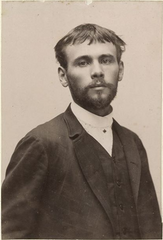
 Gustav Klimt in 1887

Gustav Klimt in 1887

Self-Portrait – Date Unknown

Self-Portrait – Date Unknown


Klimt was born in Baumgarten, a suburb of Vienna, Austria. His father, Ernst Klimt, was a gold and silver engraver. Klimt and his six siblings were all raised in a small apartment in Vienna. Klimt began drawing at a young age, and his father encouraged his artistic talents. At the age of 14 in 1876, Klimt enrolled at the Vienna School of Applied Arts, where he studied architecture and painting. In 1877 his brother, Ernst, only 13 at the time, also enrolled in the school.

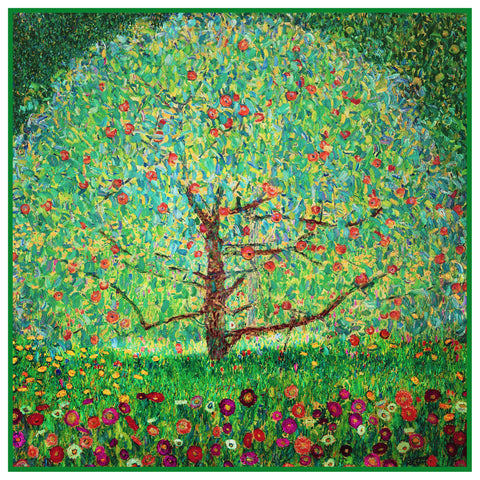
Apple Tree I, by Gustav Klimt 1912

Apple Tree I, by Gustav Klimt 1912

Klimt's professors, Ferdinand Laufberger, and after his sudden passing, Julius Victor Berger, were among those painters who participated in numerous decorative painting assignments for the recently constructed public and private buildings along Vienna's Ringstrasse.  Laufberger included the Klimt brothers as assistants on some of these projects.  By 1881, the two brothers and their friend, Franz Matsch, began working together as a team, having received numerous commissions.  They called their new company "Künstler-Compagnie" (Artists Company). They moved to a collective studio in Sandwirthgasse 8 in the sixth Vienna district where they had space to create larger works as well.

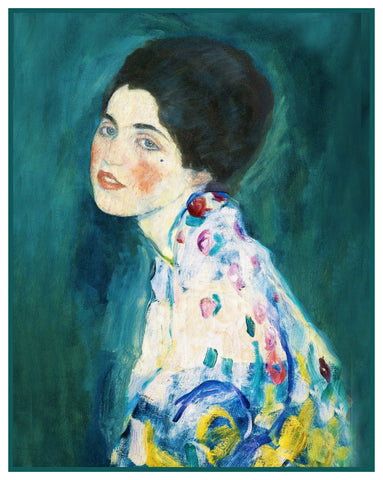
Portrait of a Lady by Gustav Klimt, 1917

Portrait of a Lady by Gustav Klimt, 1917

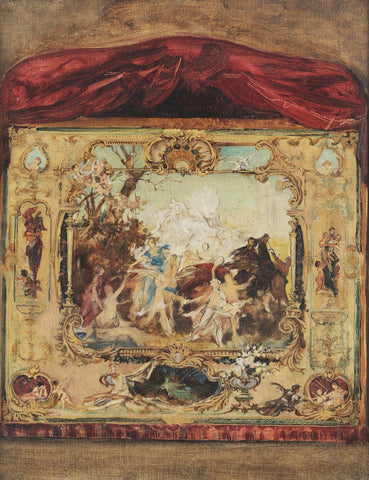
The company received its first assignments from architectural firm Fellner & Helmer, which erected theater buildings throughout the monarchy and needed curtains and ceiling paintings to furnish them. The young painters produced the ceiling paintings for the newly built theater in the Dalmatian coastal town of Fiume (now Rijeka, Croatia) and the ceiling paintings and curtains for the theaters in Carlsbad, Bohemia (now Karlovy Vary, Czech Republic) and Reichenberg (now Liberec, Czech Republic).

Theater Curtain in the Municipal Theater in Karlovy Vary, Czech Republic - Gustav Klimt 1886

Theater Curtain in the Municipal Theater in Karlovy Vary, Czech Republic - Gustav Klimt 1886

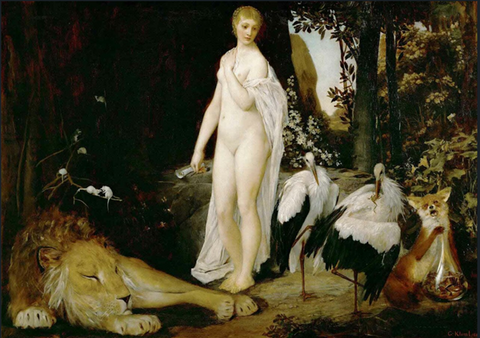
From 1883 to 1884 Klimt created other works intended as illustrations for the "Allegories and Emblems" design collection. Viennese publisher Gerlach & Schenk released richly illustrated books from 1882 to 1885 and invited numerous artists to provide allegorical depictions for them. Klimt created the two paintings "Allegory of Fable" and "Allegory of Idyll" as well as several detailed drawings. Klimt was still painting in the then-popular neoclassicism style in these works. He executed them in a refined, meticulously detailed, realistic style.

Allegory of Fable, Gustav Klimt 1884

Allegory of Fable, Gustav Klimt 1884

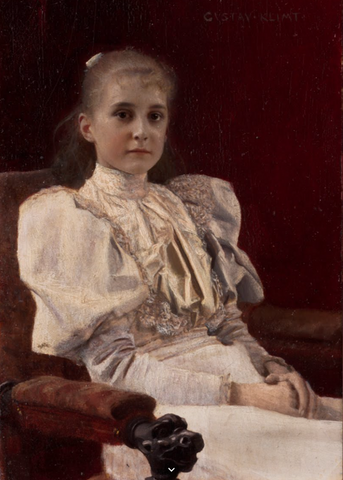
In addition to the ceilings and murals and other works that Klimt and his brother had been commissioned to complete, Klimt was in demand to paint portraits.  In these portraits created in the late 1880s and early 1890s, the young painter developed an astounding level of realism. Each detail was produced to an almost microscopic degree of perfection. These works are an impressive demonstration of the great artistry and technical painting expertise Gustav already possessed at the time.

Gustav Klimt, Young Girl sitting, 1894, Leopold Museum, Vienna, Austria.

Gustav Klimt, Young Girl Sitting, 1894, Leopold Museum, Vienna, Austria.

In the early 1890s Klimt met Austrian fashion designer Emilie Louise Flöege (a sibling of his sister-in-law) who was to be his companion until the end of his life. 

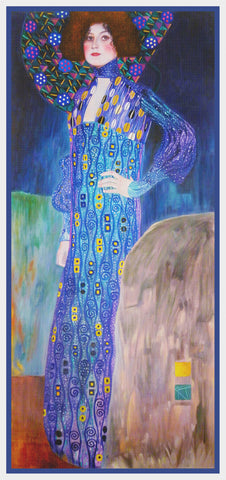
Portrait of Emilie Flöege by Gustav Klimt, 1902

Portrait of Emilie Flöege by Gustav Klimt, 1902

 Klimt became a member of the Vienna visual artists co-operative, the Künstlerhaus, which at the time was the most important artists association in Vienna. In 1892 the Artists Company moved to a studio in Josefstädter Straße 21 in Vienna's eighth district. The success of the artist company took a severe hit, however, when Gustav's brother Ernst died unexpectedly in 1892. Klimt's father also died in the same year. The artist company was dissolved, and Klimt fell into a deep creative crisis. Matsch moved out of the shared studio and Klimt continued to work there alone. In 1894 Klimt, his mother, brother Georg, and his two unmarried sisters Klara and Hermine moved to an apartment in Westbahnstrasse 36 in the seventh district of Vienna.   He would spend the rest of his life here with his family unit, which only changed when Georg married and when their mother died in 1915.

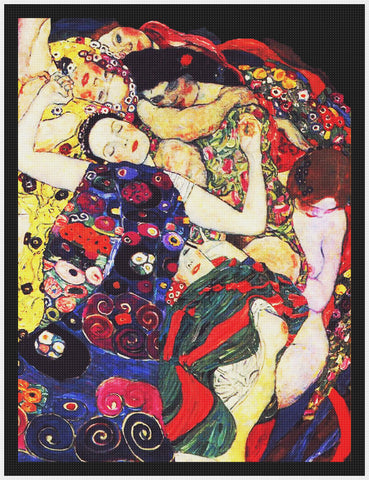
The Virgin by Gustav Klimt, 1913

The Virgin by Gustav Klimt, 1913


Klimt's mature style emerged in the late 1890s. In 1897, Klimt founded the Vienna Secession, a group of artists and architects who rebelled against the conservative academic art establishment. The Secessionists sought to create a new, modern style of art that was influenced by Art Nouveau, Symbolism, and Japanese art. Klimt became the president of the Secession, and he played a leading role in organizing its exhibitions and promoting its ideals.  The Secessionists held regular exhibitions in Vienna, which featured the work of both Austrian and international artists. They also published a journal, Ver Sacrum, which promoted their ideas and showcased the work of their members. The Vienna Secession was one of the most important art movements of its time. It played a leading role in the development of Art Nouveau and helped to usher in a new era of modern art.  The group disbanded in 1908, but its influence can still be seen in the work of artists and designers around the world.

Detail from the Tree of Life by Gustav Klimt, 1909

Detail from the Tree of Life by Gustav Klimt, 1909

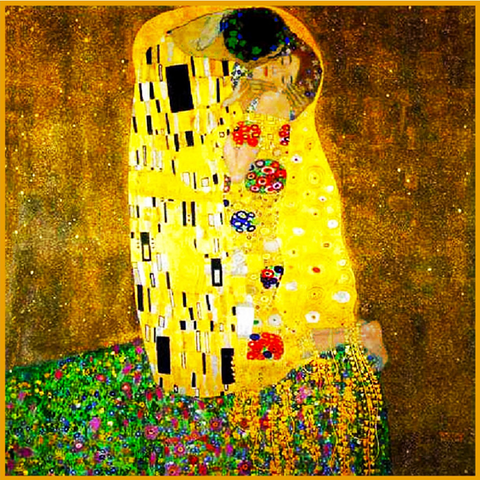
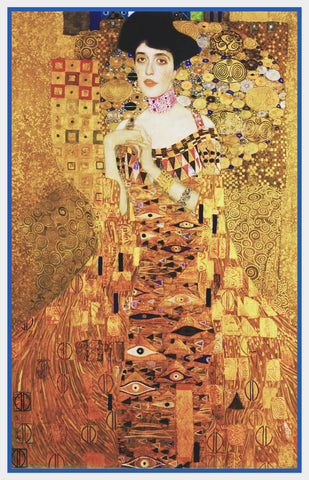
His paintings from this period are characterized by their use of gold leaf (likely influenced by his father’s work as a gold engraver), elaborate patterns, and symbolic imagery. Klimt's most famous paintings include "Judith and the Head of Holofernes" "The Kiss" and "Adele Bloch-Bauer I".

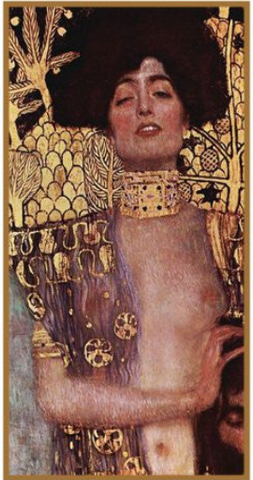
"Judith and the Head of Holofernes" (1901) is a powerful and disturbing depiction of the biblical story of Judith, a beautiful widow who seduces and then decapitates the Assyrian general Holofernes in order to save her home city of Bethulia.

Judith and the Head of Holofernes by Gustav Klimt

 Judith and the Head of Holofernes by Gustav Klimt, 1901

The painting is a complex and ambiguous work of art. It is both beautiful and disturbing, and it has been interpreted in many different ways. The painting is dominated by the figure of Judith, who is shown standing over the severed head of Holofernes. She is wearing a lavish golden gown, and her hair is styled in a fashionable updo. Judith's expression is calm and serene, but her eyes are fixed on the viewer with an unsettling intensity.  In her left hand, she holds the severed head of Holofernes by the hair.

"The Kiss" (1907) is one of the most iconic and beloved works of art in the world. It depicts a couple embracing in a golden, jewel-encrusted setting, their bodies and faces intertwined in a timeless gesture of love and passion.

The Kiss by Gustav Klimt (1907)

 The Kiss by Gustav Klimt (1907)

The painting is a masterpiece of symbolism and Art Nouveau design. The couple's cloaks are decorated with intricate patterns and motifs that represent love, fertility, and the passage of time. The gold leaf that covers the background and many of the figures gives the painting a sense of luxury and opulence.

The Kiss is also a deeply personal work of art. Many believe that it is a self-portrait of Klimt with his lover, Emilie Flöege. The painting was created at a time of great personal and artistic upheaval for Klimt, and it reflects his deep search for meaning and purpose in life. 

The Kiss was first exhibited in 1908, and it was immediately met with critical acclaim. The painting has since been reproduced countless times and has become a symbol of love and romance around the world. It is currently on display at the Upper Belvedere Museum in Vienna, Austria.

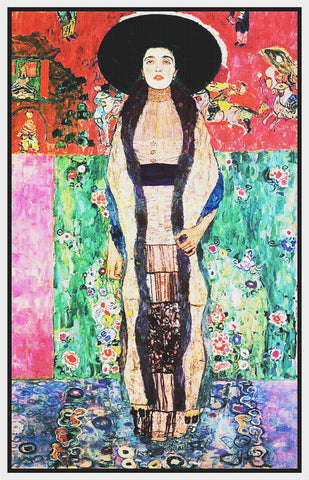
Another Klimt masterpiece is the Portrait of Adele Bloch-Bauer, the wife of a wealthy Jewish banker, Ferdinand Bloch-Bauer. It was painted between 1903 and 1907.

Portrait of Adele Bloch-Bauer I, by Gustav Klimt (1907)

Portrait of Adele Bloch-Bauer I, by Gustav Klimt (1907)

The painting is considered to be one of the most iconic works of art from the Art Nouveau movement. It is also one of the most valuable paintings in the world, having sold for US$135 million in 2006.


The painting depicts Adele Bloch-Bauer sitting on a golden throne or chair, in front of a golden starry background. She is wearing a lavish gown that is decorated with gold leaf and intricate patterns. Her neck is adorned with a jeweled choker, and her head is surrounded by a halo of gold.  Klimt's use of gold leaf in the painting gives it a sense of luxury and opulence. The intricate patterns and motifs on Adele's gown and chair represent her wealth and status. The golden starry background symbolizes her divinity and immortality.

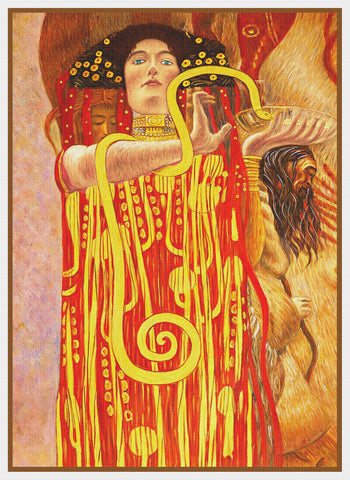
Hygieia by Gustav Klimt (1907)

Hygeia by Gustav Klimt (1907)

Klimt also painted a number of lesser-known works that are equally beautiful and fascinating.  Here are a few examples:

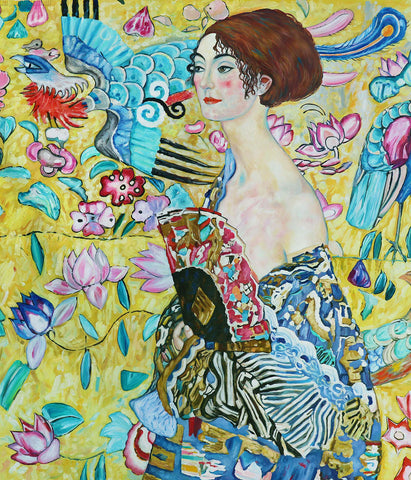
The Lady with the Fan (1898): This portrait of a young woman is one of Klimt's most elegant and sensual works. The woman is shown wearing a lavish gown and holding a fan. Her expression is enigmatic and seductive.

The Lady with the Fan by Gustav Klimt (1898)

The Lady with the Fan by Gustav Klimt (1898)

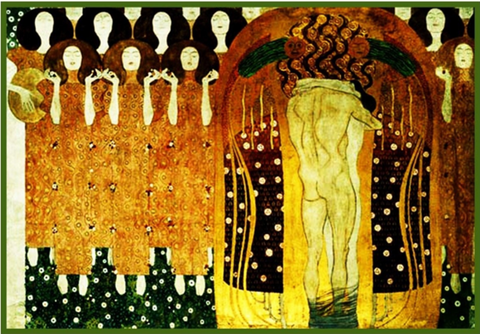
The Beethoven Frieze (1901-02): This frieze was commissioned by the Vienna Secession for the 14th Beethoven Exhibition. It is a musical interpretation of Beethoven's Ninth Symphony, and it depicts a variety of figures, including angels, demons, and warriors. The frieze is a complex and visually stunning work of art.

The Beethoven Frieze (1901-02), a Large Scale Painting by Gustav Klimt

The Beethoven Frieze (1901-02), a Large Scale Painting by Gustav Klimt

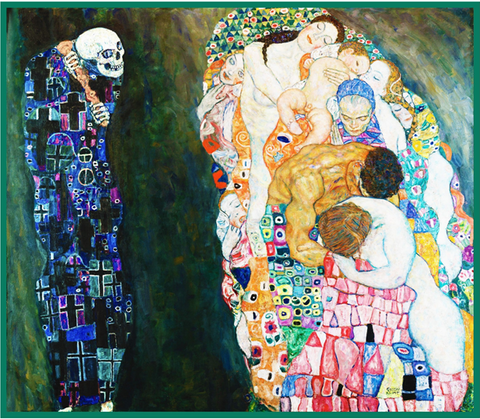
Death and Life (1908-11): This large-scale painting depicts Death and Life as two sides of the same coin. Death is shown as a skeletal figure, while Life is shown as a young woman with a baby in her arms. The painting is a powerful meditation on the cycle of life and death.

Death and Life by Gustav Klimt (1908-11)

Death and Life by Gustav Klimt (1908-11) 


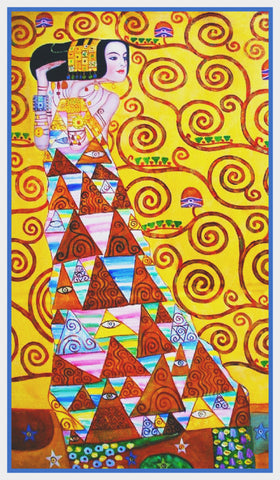
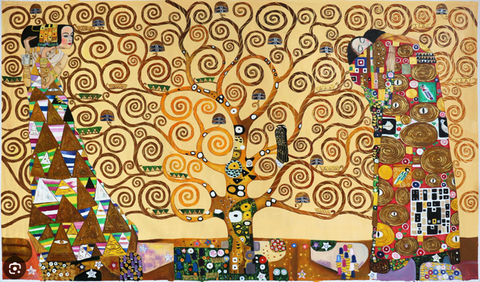
The Tree of Life (1909-11): This painting is a celebration of life and fertility. It depicts a tree with golden branches and leaves, and it is surrounded by a variety of animals and plants. The painting is a symbol of hope and regeneration.

The Tree of Life by Gustav Klimt (1909-11):

The Tree of Life by Gustav Klimt (1909-11)

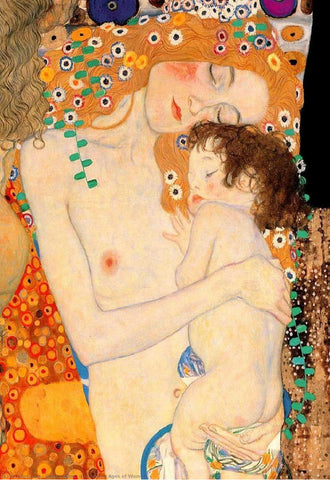
The Three Ages of Woman (1905): This painting depicts three women at different stages of life: a young girl, a mother, and an old woman. The painting is a reflection on the passage of time and the inevitability of death.


The Three Ages of Woman by Gustav Klimt, 1905 (Detail)

The Three Ages of Woman by Gustav Klimt, 1905 (Detail)

Klimt's work was often controversial, and he was criticized for his frank portrayal of sexuality and his use of religious and mythological themes in a secular context. However, Klimt was also one of the most successful artists of his time. He received numerous awards and commissions, and his work was exhibited in major galleries and museums around the world.

Klimt died in Vienna on February 6, 1918, following a stroke. He was 55 years old. Klimt's legacy as one of the most important and influential artists of the Art Nouveau movement is secure. His work continues to be exhibited and admired in galleries and museums around the world.

One more interesting tidbit - Adele Bloch-Bauer was the only person whose portrait was painted twice by Klimt.  Both of her portraits hung in the Bloch-Bauer family home until they were stolen by the Nazis during World War II.  After a lengthy court battle, the paintings were returned to Maria Altmann, the niece of Ferdinand Bloch-Bauer, in January 2006.

Portrait of Adele Bloch-Bauer II, by Gustav Klimt (1912)

Portrait of Adele Bloch-Bauer II, by Gustav Klimt (1912)

In June 2006 the Portrait of Adele Bloch-Bauer I was sold to Ronald Lauder for $135 million for his public art museum, at the time a record price for a painting.  In November of that year, Christie's auction house sold Portrait of Adele Bloch-Bauer II at auction for almost $88 million, the fourth-highest priced piece of art at auction at the time. The buyer was Oprah Winfrey.

The two paintings had a brief reunion at Neue Galerie in New York for the exhibition "Klimt and the Women of Vienna’s Golden Age, 1900–1918.  The Portrait of Adele Bloch-Bauer I remains on display at Neue Galerie.  During the summer of 2016, Winfrey sold Portrait of Adele Bloch-Bauer II to an unidentified Chinese buyer for $150 million.

Read more →

The Gilded Vine: How Alfons Mucha Defined the Look of an Era

Princess Hyacinth Detail By Alfons Mucha


Was Alfons Mucha the Creator and Founder of the Art Nouveau Movement? On the purely subjective scale I would emphatically say yes! When I look at an art nouveau illustration the fluidity and color is what I notice first. I find that the female forms are what I am drawn to the most. While Gustav Klimt is the art nouveau artist best known for drawing and painting females I love the fluidity and graceful arcs of Alfons Mucha’s women.

  
 The Arts Poetry Sketch

The Arts Poetry finished piece By Alfons Mucha

In Poetry from the Arts Series you can see the concept and the graceful lines in his sketch and then the boldness in his finished piece.   I think I like the sketch better for the soft gracefulness.  In my opinion, Alfons Mucha is the artist that created and focused the art nouveau movement.

Self portrait

Czech-born Alfons Maria Mucha also known as Alphonse Mucha (1860 – 1939) is one of the most celebrated artists of the Art Nouveau Style. He has gained international acclaim his elegant designs for decorative paintings, panels, and advertising posters.


Alfons Mucha was born in 1860, in Ivancice, Moravia, which is near the city of Brno in the modern Czech Republic. Born in a small town his upbringing was not sophisticated. He had a traditional upbringing attending the local schools and taking part in local functions including singing in the church choir. As most of the artists of his day, Mucha ended up in Munich and  Paris in 1887. He was a little older than many of his fellow artists.  He had found a patron; Count Karl Khuen of Mikulov in Moravia, prior to his move. After two years in Munich most of which was painting murals for his patron, he was sent off to Paris where he studied at the Academie Julian. After two years, his patron moved on and the 27-year-old artist was broke and moved to Paris. He lived in an apartment above a creperie and lived off small artistic jobs and teaching art to students. 


Gismonda Poster By Alfons Mucha
          

In 1897 Mucha created a poster for Sarah Bernhardt's play, Gismonda, The poster embodied his art philosophy and was a statement of his new art. Spurning the bright colors and the more squarish shape of the more popular poster artists, the near life-size design was a sensation.

The Feather Poster By Alfons Mucha

Mucha produced a great number of paintings, posters, advertisements, book illustrations, as well as designs for jewelry, carpets, wallpaper, and theatre sets in what was termed initially The Mucha Style but became known as Art Nouveau (French for "new art"). Mucha's works frequently featured beautiful young women in flowing, vaguely Neoclassical-looking robes, often surrounded by lush flowers which sometimes formed halos behind their heads. In contrast with contemporary poster makers he used pale pastel colors.

Green Reverie Poster By Alfons Mucha

By 1898, he had moved to a new studio, and had his first one-man show.  He began publishing graphics with Champenois, a new printer anxious to promote his work with postcards and panneaux – which were sets of four large images around a central theme (four seasons, four times of day, four flowers, etc.


La Trappistine Detail By Alfons Mucha

Mucha's style was given international exposure by the 1900 Universal Exhibition in Paris, when he decorated the Bosnia and Herzegovina Pavilion and collaborated with other artists decorating the Austrian Pavilion. Mucha’s Art Nouveau style was often lauded and imitated. The Art Nouveau style however, was what Mucha attempted to disassociate himself with for the rest of his life. He was constantly caught between being a successful artist and and making a meaningful contribution.

Advertisement for Waverly Cycles

By Alfons Mucha

Mucha married Maruška (Marie/Maria) Chytilová in 1906, in Prague. The couple traveled to the U.S. from 1906 to 1910, during which time their daughter, Jaroslava, was born in New York City. They also had a son, Jiří, who was born in 1915 in Prague. In the United States, Mucha expected to earn money to fund his nationalistic projects to demonstrate to Czechs that he had not "sold out". He was assisted by millionaire Charles R. Crane, who used his fortune to help promote revolutions and, after meeting Thomas Masaryk, Slavic nationalism. Alphonse and his family returned to Czechoslovakia and settled in Prague. His first project was to decorate the Theater of Fine Arts.  He volunteered his time and talents by creating the murals in the Mayor's Office at the Municipal House, and other landmarks around the city. When Czechoslovakia won its independence after World War I, Mucha designed the new postage stamps, banknotes, and other government documents for the new state.

 Jaroslava Mucha by her father Alfons Mucha

 Mucha spent many years working on what he considered his life's fine art masterpiece, The Slav Epic (Slovanská epopej), a series of twenty huge paintings depicting the history of the Czech and the Slavic people and gifted it  to the city of Prague in 1928. He had wanted to complete a series such as this, a celebration of Slavic history, since he was young.


The Slav Epic (Slovanská epopej), a series of twenty huge paintings depicting the history of the Czech and the Slavic people 


Mucha’s work enjoys great popularity today, however, when he died his work was considered outdated. Through the past century Mucha’s work has enjoyed waves of revivals and it seems as though his style is one of the most often cited as an influence for your artists and designers.


Madonna of the Lilies By Alfons Mucha

His son, author Jiří Mucha, devoted much of his life to writing about him and bringing attention to his artwork. In his own country, the new authorities were not interested in Mucha. His Slav Epic was rolled and stored for twenty-five years before being shown in Moravsky Krumlov, and a Mucha museum opened in Prague, managed by his grandson John Mucha.

Poster for 6th Sokol Festival 1912

Chocolat Ideal Poster By Alfons Mucha

Read more →

Alice Bailly: A Pioneer of Swiss Avant-Garde Art, from Cubism to Dada to Surrealism… You Have To See Her Wool Paintings!

Alice Bailly: A Pioneer of Swiss Avant-Garde Art, from Cubism to Dada to Surrealism… You Have To See Her Wool Paintings!


Read more →

Joaquín Sorolla y Bastida - Illuminating the Canvas with Captivating Colors!


Photograph of Joaquín Sorolla y Bastida ca. 1917


Joaquín Sorolla y Bastida, was a Spanish painter who excelled in the painting of portraits, landscapes, and monumental works of social and historical themes. Many of his works highlight the people, landscapes, and ocean water illuminated by the bright sunlight of his native Spain.

Clotilde-And-Elena-On-The-Rocks Javea by Joaquín Sorolla ca.1905


Sorolla was born in Valencia, Spain, in 1863. He showed an early talent for painting and was admitted to the Academy of San Carlos in Valencia at the age of 15. After further studies in Rome and Paris, he returned to Valencia in 1888. 


Setting Out to Sea by Joaquín Sorolla ca.1909


Sorolla's early work was influenced by the Impressionists, but he soon developed his own unique style. His paintings are characterized by their use of light and color, and their depiction of everyday life in Spain. Sorolla was particularly interested in capturing the movement and energy of people, and his paintings often feature scenes of children playing, families enjoying the outdoors, and workers at their jobs.

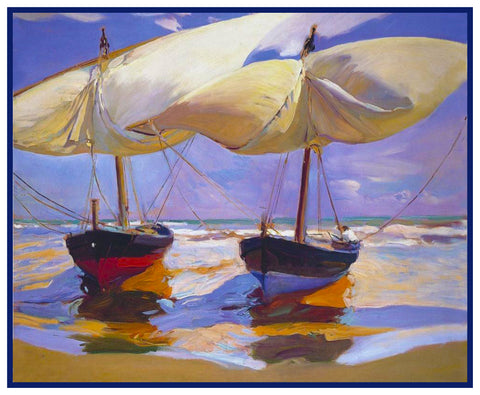
Beached Boats by Joaquín Sorolla  ca.1915

Sorolla was a very kind and generous man. He was always willing to help others, and he was especially fond of children. He would often paint children playing, and he would often give away his paintings to children in need.

Painting on the Beach by Joaquín Sorolla ca.1909

One day, Sorolla was walking through the streets of Valencia when he saw a group of children playing. He stopped to watch them, and he was struck by how happy they were. He asked the children if he could paint them, and they were thrilled. Sorolla spent the afternoon painting the children, and when he was finished, he gave the painting to them as a gift. The children were so happy, and they thanked Sorolla profusely.

Sorolla painting in the garden of his house, 1920

This story is just one example of Sorolla's kindness and generosity. He was a man who loved life and who loved to share his love of life with others. He was a true artist, and he was a true gentleman.

My Wife and Daughters in the Garden by Joaquín Sorolla  ca.1910

Sorolla was a very loving husband and father. He was devoted to his wife, Clotilde, and their three children, María, Elena, and Joaquín. He would often paint his family, and he would often write about how much he loved them.


Hispanic Society of America, New York City by Joaquín Sorolla  painted 1913-1919

In 1911, Sorolla received a request from the Hispanic Society of America to create a monumental series of paintings that would depict the diverse regions, cultures, and history of Spain. This ambitious project, known as the "Vision of Spain," aimed to showcase the rich heritage of Spain to an American audience.

Bride From Lagartera by Joaquín Sorolla  ca.1912

Sorolla eagerly accepted the commission and embarked on a journey across Spain, spending years traveling and meticulously studying the different landscapes, traditions, and costumes of various regions. He sought to capture the essence and soul of Spain in his artwork.

Castilla. La fiesta del pan by Joaquín Sorolla ca. 1913

The resulting series of 14 large-scale murals, each measuring around 14 feet in height and 10 feet in width, is a testament to Sorolla's extraordinary talent. The paintings showcase scenes of Spanish life, including fishing villages, bullfighting, religious processions, and agricultural activities.

Vision of Spain (formerly, The Provinces of Spain): Ayamonte by Joaquín Sorolla  

To ensure the accuracy and authenticity of his work, Sorolla meticulously researched and employed live models, often involving local communities and even his own family members in the process. He was known to work outdoors, capturing the effects of natural light and the vibrant colors of Spain.

The Horses Bath by Joaquín Sorolla  ca.1909

When the completed murals were exhibited at the Hispanic Society of America in 1919, they received critical acclaim and were considered a triumph. The intricate details, vibrant colors, and dynamic compositions showcased Sorolla's ability to capture the spirit of Spain in a captivating and immersive manner.

Joaquín Sorolla  Painting The Horses Bath 1909


Sorolla's "Vision of Spain" murals continue to be displayed at the Hispanic Society of America in New York City, where they serve as a testament to the artist's incredible skill and dedication. This project remains one of Sorolla's most celebrated achievements, and it stands as a lasting tribute to the beauty and cultural heritage of Spain.


Self-portrait by Joaquín Sorolla ca.1909


Fishermen from Valencia by Joaquín Sorolla  ca.1895

Sorolla was a prolific painter, and he produced over 2,000 works during his lifetime. His paintings are held in major museums around the world, including the Metropolitan Museum of Art in New York, the Prado Museum in Madrid, and the National Gallery in London.

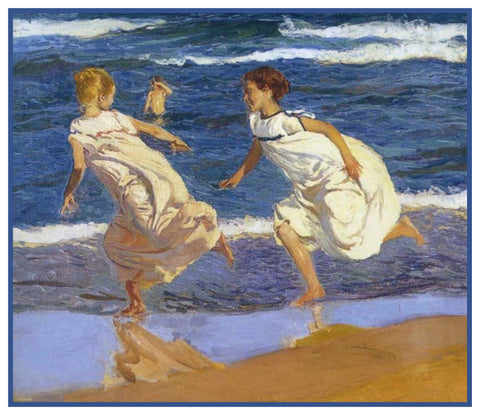
Running Along The Beach by Joaquín Sorolla  ca.1908

Sorolla was a popular and successful artist during his lifetime, and he was awarded numerous prizes and honors. He was also a member of the Real Academia de Bellas Artes de San Fernando, the highest honor in Spanish art.


Walk on the Beach by Joaquín Sorolla ca. 1909

Sorolla died in Cercedilla, Spain, in 1923. He is considered one of the most important Spanish painters of the 20th century, and his work continues to be admired by people all over the world.

Mending the Sail by Joaquín Sorolla ca. 1896

Sorolla's paintings are a celebration of life and the beauty of the natural world. They are full of light, color, and movement, and they capture the essence of everyday life in Spain. Sorolla's work is a testament to his talent and his love of life.


Niña by Joaquín Sorolla ca. 1904


Read more →

From Daughter to Designer: The Artistic Thread of May Morris


Five pink flowers with foliated tendrils Morris and Company Embroidery Designed by May Morris late 19th century


May Morris in the Tapestry Room at Kelmscott Manor’ (1912) by Mary Annie Sloane © William Morris Gallery, London Borough of Waltham Forest

May Morris, born Mary Morris in 1862, was the younger daughter of William Morris and Jane Morris. Growing up within the artistic and intellectual circle of her parents profoundly shaped her life and career. She was immersed in the Arts and Crafts movement from a young age, surrounded by her father's colleagues and friends, including artists like Dante Gabriel Rossetti and Edward Burne-Jones. This environment fostered her early artistic development and instilled in her a deep appreciation for craft and design.  

Left to right: Edward Jones, Margaret Burne-Jones, Edward Burne-Jones, Philip Burne-Jones, Georgiana Burne-Jones, May Morris, William Morris, Jane Morris, and Jenny Morris; platinotype photograph, 5 1/2 x 5 1.8 inches photo by Fredrick Hollyer


May's artistic talents manifested early, particularly in embroidery. She learned this craft from her mother, Jane, and her aunt, Bessie Burden, who had been taught by William Morris himself. This familial training laid the foundation for her future success in textile arts. By the time she was in her early twenties, May had already begun to make significant contributions to the family firm, Morris & Co.  

Honeysuckle wallpaper designed by May Morris in 1883

In 1881, May Morris enrolled at the National Art Training School in Kensington (later the Royal College of Art) and chose embroidery as her field of study. Developing and honing the skills taught to her by her mother and aunt, May displayed an exceptional talent for the craft. It’s worth noting that she also had a talent for drawing and painting, too, and in 1883, she designed one of Morris & Co.’s most enduring and popular surface pattern designs – ‘Honeysuckle’. In 1885,

May Morris, “Woven Seat Cover” (n.d.), wool tapestry, 20 1/2 x 20 1/2 inches (© William Morris Gallery, London Borough of Waltham Forest


In 1885, at the young age of 23, May Morris became the Director of the Embroidery Department at Morris & Co. This appointment demonstrated her exceptional skill and expertise in the field. She was responsible for producing a wide range of designs, and her contributions played a crucial role in the firm's success. However, it's important to note that many of her designs were often attributed to her father, which somewhat obscured her individual artistic achievements.  

May Morris, “Cushion Cover,” (c. 1890), linen plain weave with silk embroidery (image via Rhode Island School of Design)

May was a highly skilled designer in her own right. She designed wallpapers, jewelry, lettering, and book decorations, in addition to her renowned embroidery work. She played a key role in continuing her father's emphasis on free-form embroidery, which allowed for greater self-expression in the needleworker, a departure from the more rigid styles prevalent at the time.  


May's relationship with her parents, particularly her father, was complex but deeply influential. William Morris encouraged his daughters' artistic pursuits, and May seems to have seen herself as his artistic heir. She shared his socialist ideals and was involved in the Socialist League. After her father's death, she dedicated a significant portion of her life to preserving his legacy, including editing his Collected Works.  

Her mother, Jane, also played a significant role in her artistic development, passing on her embroidery skills and fostering a creative environment within the family home. May's upbringing within this artistic household, surrounded by influential figures, undoubtedly shaped her artistic vision and her commitment to the Arts and Crafts movement.  


Beyond her artistic endeavors, May shared her father's socialist beliefs and advocated for the rights of women and workers. In 1907, she co-founded the Women's Guild of Arts, an organization that provided support and networking opportunities for women artists and craft workers, highlighting her commitment to advancing the role of women in the arts.  

Tulip Pot designed by May Morris around 1900


May Morris was known to have a strong and independent personality. She was described as having a "tomboyish" nature in her youth and possessed a direct and sometimes critical demeanor. She was passionate in her beliefs and advocated for her artistic vision and social causes with determination.  

May Morris and Theodosia Middlemore, “Embroidered hanging of wool on linen depicting a pomegranate tree, roses and other flowers, foliage and birds” (1891–1902) (© National Museums Scotland, courtesy National Museums Scotland)

She had a complex personal life, including a brief marriage to Henry Halliday Sparling, which ended in divorce. She also had significant relationships outside of her marriage. Her life was marked by both artistic dedication and personal challenges.  

Morris, Henry Halliday Sparling, Emery Walker, and George Bernard Shaw rehearsing for a Socialist League entertainment, c. 1886


May Morris's contributions to the Arts and Crafts movement were significant, and her artistic legacy continues to be recognized today. She was a talented designer, a skilled craftswoman, and a passionate advocate for art and social justice.


Rose Bush designed by May Morris around 1890

While often overshadowed by her famous father, May developed her own distinctive style and made significant contributions to the field of textile arts. Her embroidery work was characterized by its exquisite craftsmanship, intricate detail, and a move towards more naturalistic and flowing designs, building upon the foundations laid by her father but incorporating her own artistic sensibilities.  

The Orange Tree 1897 by May Morris


One of May's key contributions was her championing of "artistic needlework" or free-form embroidery. This approach emphasized the skill and artistic expression of the individual needleworker, allowing for greater creativity in the interpretation of designs. Unlike the more rigid, counted thread techniques popular at the time, May's embroidery encouraged a more painterly approach with the needle, utilizing a variety of stitches and thread colors to create texture and depth. This can be seen in her floral motifs, where petals and leaves are rendered with subtle variations in shading and direction of stitch, giving them a lifelike quality.  

May Morris Created and Stitched a Dress For a Friend  1882

As Director of the Embroidery Department at Morris & Co., May oversaw the production of numerous important commissions, and while many designs were collaborative or attributed to William Morris, she also created her own distinct patterns. Her designs often featured naturalistic elements, including stylized flowers, foliage, and sometimes birds or animals, reflecting the broader Arts and Crafts movement's inspiration from the natural world. Her understanding of color and her ability to translate designs into the medium of thread were highly regarded.  

Necklace designed by May Morris c.1906


Beyond embroidery, May Morris also demonstrated her artistic talents in other design fields. She created wallpaper patterns, jewelry, and book decorations, showcasing a versatile artistic sensibility rooted in the principles of the Arts and Crafts movement – an emphasis on quality materials, skilled craftsmanship, and the integration of art into everyday life. While her embroidery remains her most celebrated contribution, her broader design work further illustrates her significant role in shaping the visual aesthetic of the late 19th and early 20th centuries.  

Acanthus Vine by May Morris 1890

Today, May is increasingly celebrated not just as her father's daughter, but as a formidable artist, designer, and influential figure in the Arts and Crafts era, with her intricate embroideries and progressive spirit continuing to inspire contemporary artists and designers.

Wildflowers Inspired by May Morris Melsetter Tapestry

Read more →